Our Ethos, Behaviour and Relationships
Creating a school where every child feels they belong, learns to regulate their emotions, builds positive relationships and develops the confidence to become an active and responsible citizen.
Helping every child become the best version of themselves
At Shirley Juniors, we want all our children to have a sense of belonging within our school community, developing their self-confidence and self-worth.
We truly believe that through building connections and celebrating our pride of ourselves and others, children become the very best versions of themselves, which help them to not only be the very best learners but also develop into active and responsible citizens.
The Good Morning Club at Shirley Junior School
To support with this, we are proud to be a TGMC school.
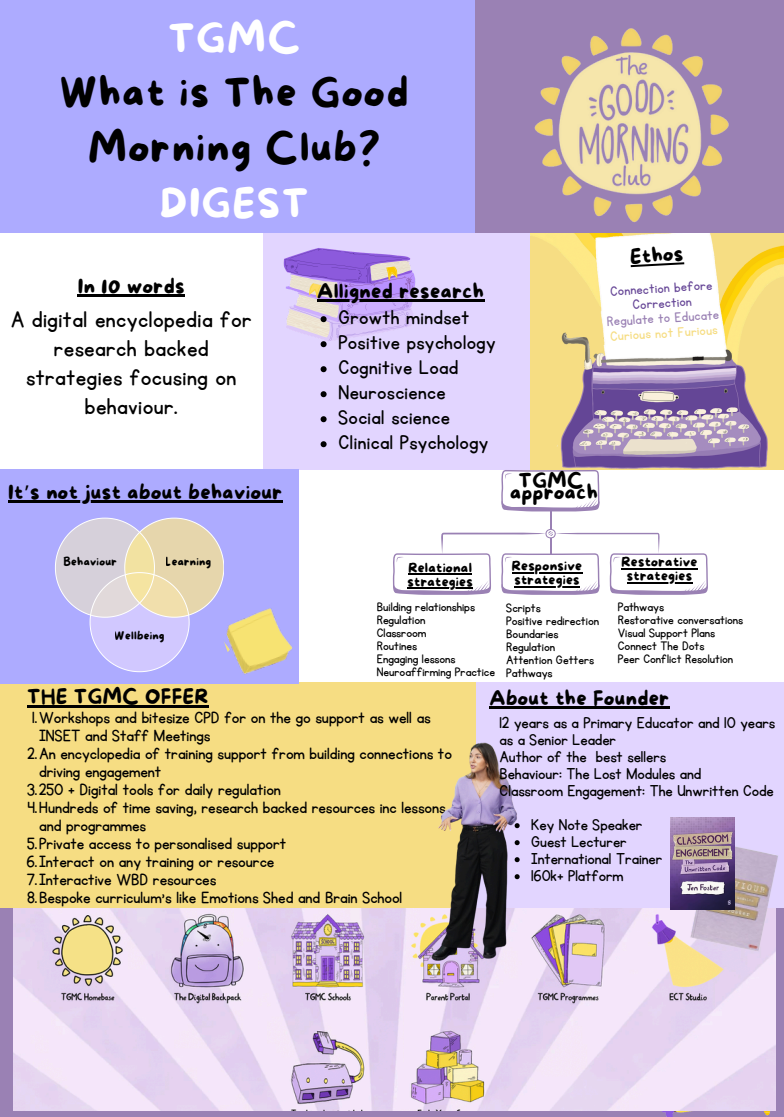
TGMC, or The Good Morning Club, is an approach that uses building connections, positive psychology and emotional regulation to create calmer, more positive, more purposeful and more engaged learning environments.
TGMC is not simply about behaviour. It brings together behaviour, learning and wellbeing so that children are supported to understand themselves, build stronger relationships and become more ready to learn.
Grounded in research and evidence
The Good Morning Club draws on a number of areas of research and practice that help schools better understand learning, behaviour, relationships and emotional regulation.
Growth Mindset
Helping children understand that abilities and confidence can develop through effort, reflection and effective support.
Positive Psychology
Building on strengths, positive relationships, belonging, confidence and wellbeing.
Cognitive Load
Recognising the importance of creating environments where children are emotionally and cognitively ready to learn.
Neuroscience
Supporting children to understand their emotions, regulation and responses.
Social Science
Understanding the importance of relationships, communities and connections in how children develop.
Clinical Psychology
Drawing on established approaches to behaviour, emotional regulation and positive relationships.
Five principles that shape our approach
Curious not Furious
We seek to understand what may be driving behaviour before reacting to it.
Regulate to Educate
Children learn best when they are emotionally regulated and ready to engage.
Connection over Correction
Positive relationships provide the foundation for behaviour, wellbeing and learning.
Connect the Dots
We look at patterns, relationships and experiences to better understand each child.
Theorise and then Systemise
We use what we understand about children to create consistent approaches and support.
Relational, responsive and restorative strategies
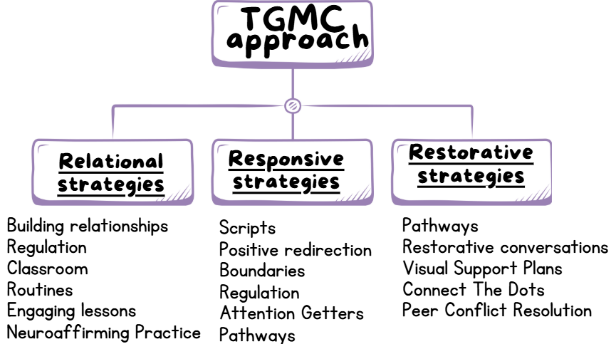
TGMC brings together three complementary types of strategy to support positive behaviour, stronger relationships and purposeful learning.
Relational Strategies
These strategies focus on creating the strong relationships and classroom conditions that help children feel safe, connected and ready to learn.
- Building relationships
- Regulation
- Classroom routines
- Engaging lessons
- Neuroaffirming practice
Responsive Strategies
These strategies help adults respond positively, consistently and appropriately when children need additional support.
- Scripts
- Positive redirection
- Boundaries
- Regulation
- Attention getters
- Pathways
Restorative Strategies
These approaches help children understand what has happened, repair relationships and learn how to move forward positively.
- Pathways
- Restorative conversations
- Visual Support Plans
- Connect The Dots
- Peer Conflict Resolution
Our ethos in action
Take a look at how our ethos, relationships and approach to wellbeing are reflected across everyday life at Shirley Junior School.
Regulation backpacks and Brain School
In all of our classrooms, regulation backpacks are used to support the emotional regulation of all children.
Children are taught how to recognise their emotions within Brain School sessions and then learn about the ‘backpacks’; different strategies which they can use to support them depending on how they are feeling.
This helps children build a practical understanding of emotional regulation and gives them tools they can use to become calmer, more confident and increasingly independent.
Ending the week with pride
We end our week by celebrating our successes in assembly, sharing our appreciations for each other.
The children also have time to share what they are proud of this week, with each class creating a ‘proud post’ which is shared with our school community.
What is The Good Morning Club?
The video below, by the founder of TGMC Jen Foster, explains what TGMC is all about, how it can help our pupils and what to expect from it.
Listen to the SJS TGMC Podcast
Our own SJS TGMC podcast gives children and staff the opportunity to talk about all things regulation and backpacks, and how TGMC continues to improve the wellbeing of all in our school community.
Hear first-hand experiences from our school community and find out more about how the approach works in everyday school life.

Behaviour and Relationships at Shirley Junior School
We are an emotionally literate school where pupils develop the skills of self-regulation and learning from mistakes by repairing and reflecting.
We foster a sense of belonging and acceptance, so children grow to become honest, responsible citizens of their community.
Distributive leadership and consistent support
We have adopted a Distributive Leadership approach to support pupils with challenging behaviour so that all staff support behaviour and are aware of their roles and responsibilities, including Governors, Senior leaders, teachers and support staff.
Behaviour needs to be taught
Equality and inclusion
All our teaching reflects the Equality Act 2010 ensuring there is no discrimination for any pupil or family with protected characteristics.
Relationships first
Adults in the school aim to develop their relationships with all children so that children feel cared for and are happy to receive influence from the adults around them, in the classroom and on the playground.
Behaviour and attitudes guidance
Our visual, one-page policy for behaviour and attitudes can be seen below.


Repair and Rebuild
When conflicts occur, we use a restorative approach called Repair and Rebuild. The children involved ask and answer the questions in the following order:
- 01 What happened?
- 02 What were you thinking at the time?
- 03 How were/are you feeling?
- 04 Who do you think has been affected?
- 05 What needs to happen to put things right?
- 06 Does there need to be an action?
Recognising learning and positive behaviour
We have many ways to celebrate and reward children for both their learning and behaviour across our school.
Behaviour and Relationships Policy
Read our full policy for further information about behaviour, relationships, expectations and support at Shirley Junior School.